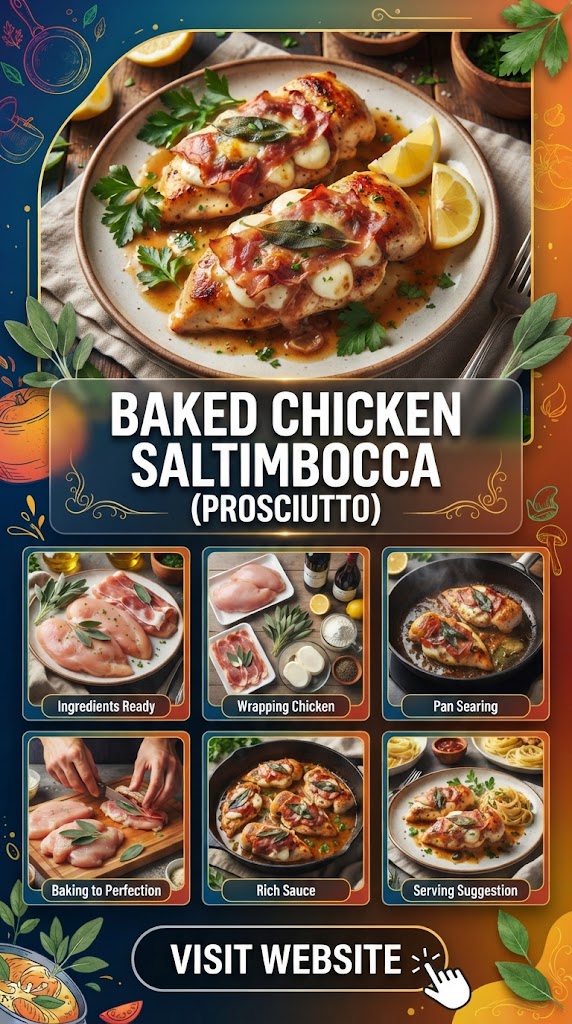
Baked Chicken Saltimbocca (Prosciutto)
Baked Chicken Saltimbocca with Prosciutto
Baked Chicken Saltimbocca is an elegant Italian-inspired chicken dinner that brings together tender chicken breasts, salty prosciutto, fresh sage, Parmesan, and a flavorful pan sauce. The name “saltimbocca” roughly translates to “jumps in the mouth,” which perfectly describes this dish: every bite combines juicy chicken with crisp prosciutto, aromatic herbs, and a rich, savory sauce.
Unlike the traditional stovetop preparation, this baked version is especially convenient for home cooks. The chicken is assembled with prosciutto and sage, lightly seasoned, baked until tender, and finished with a simple sauce made from chicken broth, lemon, butter, and white wine. The result is a restaurant-style meal that is impressive enough for guests but simple enough for a weeknight dinner.
Why You’ll Love This Baked Chicken Saltimbocca
There are many reasons this recipe deserves a place in your regular dinner rotation.
First, it uses straightforward ingredients that work beautifully together. Chicken provides a mild, hearty base, while prosciutto adds saltiness and richness. Fresh sage gives the dish its distinctive Italian character, and lemon brightens the entire plate.
Second, baking makes the cooking process easier. Instead of constantly monitoring chicken in a skillet, you can prepare everything in a baking dish and let the oven do most of the work.
Third, the finished chicken looks beautiful. The thin prosciutto layer becomes lightly crisp around the edges while the sage remains fragrant. Spoon the sauce over the chicken just before serving, and you have a meal that looks far more complicated than it actually is.
Complete Recipe
Recipe Overview
Recipe Name: Baked Chicken Saltimbocca with Prosciutto
Cuisine: Italian-inspired
Course: Main Course
Preparation Time: 20 minutes
Marinating/Resting Time: 10 minutes
Cooking Time: 25–35 minutes
Total Time: About 55–65 minutes
Servings: 4
Difficulty: Easy to Moderate
Ingredients
For the Chicken
- 4 boneless, skinless chicken breasts, about 6–7 ounces each
- 8 thin slices prosciutto
- 8–12 fresh sage leaves
- 2 tablespoons olive oil
- ½ teaspoon kosher salt
- ½ teaspoon freshly ground black pepper
- ½ teaspoon garlic powder
- ½ teaspoon Italian seasoning
- ¼ cup all-purpose flour, optional for a light coating
- ¼ cup finely grated Parmesan cheese
For the Sauce
- 1 cup low-sodium chicken broth
- ½ cup dry white wine
- 2 tablespoons fresh lemon juice
- 2 tablespoons unsalted butter
- 2 cloves garlic, finely minced
- 1 teaspoon Dijon mustard
- 1 tablespoon fresh sage, finely chopped
- ½ teaspoon black pepper
- ¼ cup grated Parmesan cheese
- 1 tablespoon chopped fresh parsley
Optional Garnishes
- Fresh sage leaves
- Fresh parsley
- Lemon wedges
- Additional Parmesan cheese
- Freshly cracked black pepper
Ingredient Notes
Chicken
Boneless, skinless chicken breasts work particularly well because they are easy to pound into thin, even pieces. Thin chicken cooks more quickly and evenly, which is important for this recipe.
You can also use boneless chicken thighs. They will produce a richer and juicier result, although the presentation will be slightly different.
Prosciutto
Prosciutto is one of the defining ingredients in chicken saltimbocca. It has a delicate texture and concentrated salty flavor.
Use thinly sliced prosciutto rather than thick slices. Thin prosciutto adheres to the chicken better and becomes lightly crisp during baking.
Because prosciutto is already salty, avoid heavily salting the chicken.
Fresh Sage
Fresh sage provides the classic saltimbocca flavor. Its earthy, slightly peppery character works beautifully with chicken and prosciutto.
Fresh sage is preferable to dried sage for this recipe. If you only have dried sage, use it sparingly because its flavor is considerably more concentrated.
Lemon
Fresh lemon juice balances the richness of the butter, Parmesan, and prosciutto. Bottled lemon juice can work in an emergency, but fresh lemon provides a cleaner flavor.
White Wine
A dry white wine such as Sauvignon Blanc, Pinot Grigio, or an unoaked Chardonnay works well.
If you prefer not to cook with wine, replace it with additional chicken broth and an extra tablespoon of lemon juice.
How to Prepare Baked Chicken Saltimbocca
Step 1: Prepare the Oven
Preheat your oven to 400°F (200°C).
Lightly grease a large baking dish with olive oil or cooking spray.
A 9 × 13-inch baking dish is ideal for four chicken breasts.
Allowing the oven to fully preheat before adding the chicken helps the meat cook consistently.
Step 2: Prepare the Chicken
Place each chicken breast between two sheets of plastic wrap or parchment paper.
Using the flat side of a meat mallet, gently pound the chicken until it is approximately ¼ to ½ inch thick.
Try to make the chicken evenly thick from edge to edge.
This step is important because thick portions take longer to cook while thinner portions can become dry.
Tip
Do not pound the chicken aggressively. The goal is to flatten it evenly, not tear or shred the meat.
Step 3: Season the Chicken
Pat the chicken dry with paper towels.
Lightly season both sides with:
- Black pepper
- Garlic powder
- Italian seasoning
Use only a small amount of salt because the prosciutto and Parmesan already contain salt.
If you want a slightly crispier exterior, lightly dust the chicken with flour.
Shake off any excess flour.
Step 4: Add Parmesan
Sprinkle a thin layer of grated Parmesan over one side of each chicken breast.
Press the Parmesan gently into the chicken.
The cheese adds savory flavor and helps create a flavorful crust beneath the prosciutto.
Step 5: Add the Sage
Place 2–3 fresh sage leaves on top of each chicken breast.
Position the sage toward the center so it remains protected beneath the prosciutto during baking.
For stronger sage flavor, you can use three leaves per chicken breast.
Step 6: Add the Prosciutto
Place two thin slices of prosciutto over each chicken breast.
The prosciutto should cover most of the surface without hanging excessively over the edges.
Gently press it down so it adheres to the chicken.
You do not need to secure the prosciutto with toothpicks if it is lying flat.
If your chicken breasts are very thin or irregularly shaped, toothpicks can be used to secure the prosciutto. Remember to remove them before serving.
Step 7: Prepare the Baking Dish
Place the chicken pieces prosciutto-side up in the prepared baking dish.
Drizzle the chicken lightly with olive oil.
Do not pour too much oil over the prosciutto because the prosciutto will naturally release some fat as it cooks.
Leave a little space between the chicken pieces so hot air can circulate.
Step 8: Make the Initial Sauce
In a bowl, whisk together:
- Chicken broth
- White wine
- Lemon juice
- Dijon mustard
- Minced garlic
- Black pepper
Pour this mixture around the chicken rather than directly over the prosciutto.
Keeping the liquid around the chicken helps preserve the texture of the prosciutto.
Step 9: Bake the Chicken
Place the baking dish in the preheated 400°F oven.
Bake for approximately 20–30 minutes, depending on the thickness of the chicken.
Start checking the chicken around the 20-minute mark.
The chicken should reach an internal temperature of 165°F (74°C) at the thickest point.
A reliable instant-read thermometer is the best way to determine doneness.
Important
Cooking time can vary considerably depending on the thickness of your chicken breasts. Do not rely solely on the clock.
Step 10: Crisp the Prosciutto
If the chicken is cooked but the prosciutto is not as crisp as you would like, switch the oven to broil.
Broil for approximately 1–3 minutes, watching carefully.
The prosciutto can go from lightly crisp to burned very quickly under the broiler.
Keep the baking dish several inches away from the broiler element.
Step 11: Rest the Chicken
Remove the chicken from the oven.
Transfer it to a clean plate or serving platter.
Let it rest for approximately 5 minutes.
Resting allows the juices to redistribute through the meat.
Do not immediately cut into the chicken after removing it from the oven.
Step 12: Make the Pan Sauce
Place the baking dish’s liquid into a small saucepan, or carefully transfer the liquid from the baking dish to a saucepan.
Add:
- 2 tablespoons butter
- Chopped fresh sage
- ¼ cup Parmesan
Place the saucepan over medium heat.
Whisk until the butter melts and the Parmesan incorporates into the sauce.
Allow the sauce to simmer gently for approximately 3–5 minutes, until slightly reduced.
Do not boil the sauce aggressively because excessive heat can cause the butter and cheese to separate.
Step 13: Finish the Sauce
Taste the sauce.
Adjust the flavor with additional:
- Lemon juice for brightness
- Black pepper for spice
- Parmesan for savory richness
- Chicken broth if the sauce is too concentrated
Finally, stir in chopped fresh parsley.
The sauce should be savory, buttery, lightly tangy, and aromatic.
Step 14: Serve
Place one chicken breast on each plate.
Spoon the warm pan sauce around and over the chicken.
Garnish with:
- Fresh sage
- Chopped parsley
- Lemon wedges
- Freshly grated Parmesan
- Freshly cracked black pepper
Serve immediately.
What Does Chicken Saltimbocca Taste Like?
Baked Chicken Saltimbocca has a wonderfully layered flavor.
The chicken itself is tender and mild. The prosciutto provides a salty, slightly savory taste, while the sage contributes an earthy herbal note.
Parmesan adds nuttiness and umami, while lemon keeps the dish from becoming too rich.
The pan sauce brings everything together with buttery, savory, and slightly acidic flavors.
The overall result is:
savory + herby + buttery + lemony + slightly salty + deeply flavorful.
Tips for Perfect Baked Chicken Saltimbocca
1. Pound the Chicken Evenly
Uneven chicken is one of the biggest causes of inconsistent cooking.
If one end is thick and another is extremely thin, the thin portion may dry out before the thickest section is cooked.
Aim for an even thickness.
2. Don’t Over-Salt
Prosciutto and Parmesan are naturally salty.
Season the chicken lightly before adding them.
You can always add more salt to the finished dish, but removing excess salt is difficult.
3. Use Fresh Sage
Fresh sage makes a noticeable difference.
It gives the dish a brighter and more authentic herbal character.
4. Keep the Sauce Around the Chicken
Pouring too much sauce directly over the prosciutto can prevent it from becoming crisp.
Instead, pour the sauce around the chicken during baking and spoon the finished sauce over the chicken when serving.
5. Use a Meat Thermometer
Chicken breast is lean and can become dry if overcooked.
Cook until the thickest portion reaches 165°F (74°C).
6. Let the Chicken Rest
Even five minutes of resting can make the chicken noticeably juicier.
How to Prevent Dry Chicken
Chicken breast can become dry when it is cooked too long.
The best approach is to:
- Pound the chicken evenly.
- Avoid excessively high cooking times.
- Use a meat thermometer.
- Remove the chicken once it reaches 165°F.
- Let it rest before slicing.
The prosciutto also helps protect the surface of the chicken while baking.
Can You Make Chicken Saltimbocca Without Wine?
Absolutely.
Replace the ½ cup white wine with:
- ½ cup chicken broth
- 1 extra tablespoon fresh lemon juice
You can also add a teaspoon of apple cider vinegar if you want additional acidity, but use it carefully.
The sauce will still be delicious without wine.
Can You Use Chicken Thighs?
Yes.
Boneless, skinless chicken thighs are an excellent alternative.
They contain more fat than chicken breasts, so they are naturally more forgiving during cooking.
To use thighs:
- Trim excess fat.
- Pound them lightly to even the thickness.
- Season lightly.
- Add sage and prosciutto.
- Bake until the thickest portion reaches 165°F.
The cooking time may differ depending on the size of the thighs.
Can You Make This Recipe Ahead?
Yes.
You can assemble the chicken several hours before cooking.
Prepare the chicken with the Parmesan, sage, and prosciutto.
Cover and refrigerate until you are ready to bake.
For best results, remove the chicken from the refrigerator about 15–20 minutes before baking while the oven preheats.
Do not leave raw chicken at room temperature for extended periods.
How to Store Leftovers
Allow leftover chicken to cool appropriately and place it in an airtight container.
Refrigerate for up to 3–4 days.
Store the sauce separately when possible.
Keeping the sauce separate makes reheating easier and helps prevent the prosciutto from becoming excessively soggy.
How to Reheat
Oven Method
Preheat the oven to 350°F (175°C).
Place the chicken in a baking dish with a small amount of broth or sauce.
Cover loosely with foil.
Heat until warmed through.
For a crispier prosciutto surface, remove the foil during the final few minutes.
Skillet Method
Place the chicken in a covered skillet over medium-low heat with a few tablespoons of broth.
Heat gently until warm.
Avoid high heat because it can dry out the chicken.
Microwave Method
Place one serving on a microwave-safe plate.
Cover loosely with a microwave-safe cover.
Heat in short intervals until warmed through.
The microwave is convenient, although the prosciutto will not remain as crisp.
Delicious Side Dishes
Baked Chicken Saltimbocca pairs beautifully with simple sides.
Garlic Mashed Potatoes
Creamy mashed potatoes are excellent with the buttery pan sauce.
Spoon some sauce over the potatoes for an especially satisfying combination.
Roasted Vegetables
Try:
- Broccoli
- Carrots
- Zucchini
- Bell peppers
- Asparagus
- Brussels sprouts
Roasted vegetables provide a pleasant contrast to the rich chicken.
Pasta
Serve the chicken alongside simple buttered pasta, angel hair, or spaghetti.
You can toss the pasta with some of the pan sauce for extra flavor.
Rice
Plain white rice, brown rice, or lemon rice can absorb the delicious sauce.
Green Salad
A crisp green salad dressed with lemon vinaigrette is a refreshing option.
Roasted Potatoes
Crispy roasted potatoes are particularly good because they provide texture while soaking up the sauce.
How to Turn This Into a Complete Dinner
For an impressive Italian-inspired dinner, serve:
Main: Baked Chicken Saltimbocca
Side: Garlic mashed potatoes
Vegetable: Roasted asparagus
Salad: Simple arugula and lemon salad
Bread: Warm crusty Italian bread
Dessert: Fresh berries or lemon cake
This combination balances richness with fresh and acidic elements.
Variations
Creamy Chicken Saltimbocca
For a creamy version, add ½ cup heavy cream to the finished pan sauce.
Simmer gently until slightly thickened.
Do not boil aggressively.
Mushroom Chicken Saltimbocca
Sauté sliced mushrooms before making the sauce.
Add the mushrooms to the pan sauce and simmer for several minutes.
The earthy mushrooms complement the sage beautifully.
Spinach Chicken Saltimbocca
Add fresh baby spinach to the sauce during the final few minutes of cooking.
Allow it to wilt before serving.
Mozzarella Version
For a richer variation, add a small amount of fresh mozzarella during the final few minutes of baking.
The mozzarella will melt over the prosciutto and chicken.
Tomato Version
Add halved cherry tomatoes to the baking dish.
Their natural sweetness and acidity pair well with the salty prosciutto.
Common Mistakes to Avoid
Using Too Much Salt
Prosciutto is already salty, so excessive seasoning can make the finished dish unpleasantly salty.
Using Thick Prosciutto
Thick slices may not crisp properly and can overpower the chicken.
Overcooking the Chicken
Chicken breast becomes dry quickly when cooked beyond its ideal temperature.
Adding Too Much Sauce Before Baking
Excess liquid over the prosciutto can prevent it from crisping.
Skipping the Resting Period
Cutting immediately into the chicken can cause more juices to escape.
Burning the Prosciutto
If using the broiler, watch the chicken continuously.
Frequently Asked Questions
What is chicken saltimbocca?
Chicken saltimbocca is an Italian-inspired dish featuring chicken combined with prosciutto and sage. It is often finished with a flavorful pan sauce containing ingredients such as butter, lemon, wine, or broth.
Can I use turkey instead of chicken?
Yes. Thin turkey cutlets can be prepared similarly. Adjust cooking time based on thickness and cook until the appropriate safe internal temperature is reached.
Can I use dried sage?
Yes, but use less. Fresh sage provides a more delicate and aromatic flavor.
Can I skip Parmesan?
Yes. Parmesan is optional, although it adds a pleasant savory depth.
Can I make this gluten-free?
Yes. Simply omit the optional flour or replace it with a gluten-free flour blend.
Also verify that your broth and other packaged ingredients are certified gluten-free if needed.
Why is my prosciutto not crispy?
The most common reason is excess moisture. Keep most of the sauce underneath or around the chicken instead of pouring it directly over the prosciutto.
You can also briefly broil the chicken at the end.
Can I freeze chicken saltimbocca?
Yes, although the texture of the prosciutto may change after freezing.
For best quality, freeze the cooked chicken in an airtight freezer-safe container for up to about 2 months.
Thaw in the refrigerator before reheating.
Nutrition Information
Approximate nutrition per serving will vary depending on the exact ingredients and portion sizes.
A typical serving provides approximately:
- Calories: 450–550
- Protein: 45–55 g
- Fat: 22–30 g
- Carbohydrates: 8–15 g
- Fiber: 1–2 g
- Sodium: 900–1,300 mg
The sodium level can vary substantially because prosciutto and Parmesan naturally contain significant amounts of sodium.
For a lower-sodium version, use reduced-sodium chicken broth, less Parmesan, and a smaller amount of prosciutto.
Chef’s Tips for Restaurant-Quality Results
For the best possible Baked Chicken Saltimbocca, focus on three things: even chicken, balanced seasoning, and a flavorful sauce.
Start by pounding the chicken to an even thickness. This produces tender chicken that cooks uniformly.
Next, remember that prosciutto is not merely a topping. It is a major seasoning component. Because it provides salt and richness, the chicken itself needs only modest seasoning.
Finally, don’t underestimate the sauce. A simple combination of chicken broth, white wine, lemon, butter, garlic, and sage can transform an ordinary chicken breast into an elegant dinner.
When serving, place the chicken on a warm plate and spoon the sauce around it rather than drowning the prosciutto. Finish with fresh herbs and lemon.
Easy Weeknight Method
If you’re short on time, simplify the recipe.
Prepare the chicken and prosciutto exactly as described.
Skip the flour if desired.
Place everything in a baking dish with chicken broth, garlic, lemon juice, and a splash of white wine.
Bake at 400°F until the chicken reaches 165°F.
While the chicken rests, quickly reduce the baking liquid with butter and fresh sage.
Dinner can be on the table in under an hour.
Final Recipe Card
Baked Chicken Saltimbocca
Prep: 20 minutes
Cook: 25–35 minutes
Total: About 55–65 minutes
Servings: 4
Ingredients
- 4 boneless, skinless chicken breasts
- 8 thin slices prosciutto
- 8–12 fresh sage leaves
- 2 tablespoons olive oil
- ½ teaspoon black pepper
- ½ teaspoon garlic powder
- ½ teaspoon Italian seasoning
- ¼ cup Parmesan cheese
- ¼ cup flour, optional
- 1 cup chicken broth
- ½ cup dry white wine
- 2 tablespoons lemon juice
- 2 tablespoons butter
- 2 cloves garlic
- 1 teaspoon Dijon mustard
- 1 tablespoon chopped fresh sage
- 1 tablespoon fresh parsley
Directions
- Preheat the oven to 400°F (200°C).
- Lightly grease a 9 × 13-inch baking dish.
- Pound the chicken breasts to approximately ¼–½ inch thick.
- Season lightly with pepper, garlic powder, and Italian seasoning.
- Dust lightly with flour if desired.
- Sprinkle Parmesan over each chicken breast.
- Place fresh sage leaves on top.
- Cover each chicken breast with two slices of prosciutto.
- Place the chicken prosciutto-side up in the baking dish.
- Whisk together chicken broth, white wine, lemon juice, Dijon mustard, garlic, and pepper.
- Pour the liquid around the chicken.
- Drizzle the chicken lightly with olive oil.
- Bake for approximately 20–30 minutes, depending on thickness.
- Check that the chicken reaches 165°F (74°C) internally.
- Broil for 1–3 minutes if you want crispier prosciutto.
- Remove the chicken and let it rest for 5 minutes.
- Transfer the baking liquid to a saucepan.
- Add butter, fresh sage, and Parmesan.
- Simmer gently for 3–5 minutes until slightly reduced.
- Stir in fresh parsley.
- Spoon the sauce over and around the chicken.
- Garnish with fresh sage, parsley, Parmesan, and lemon.
- Serve immediately with your favorite side dishes