
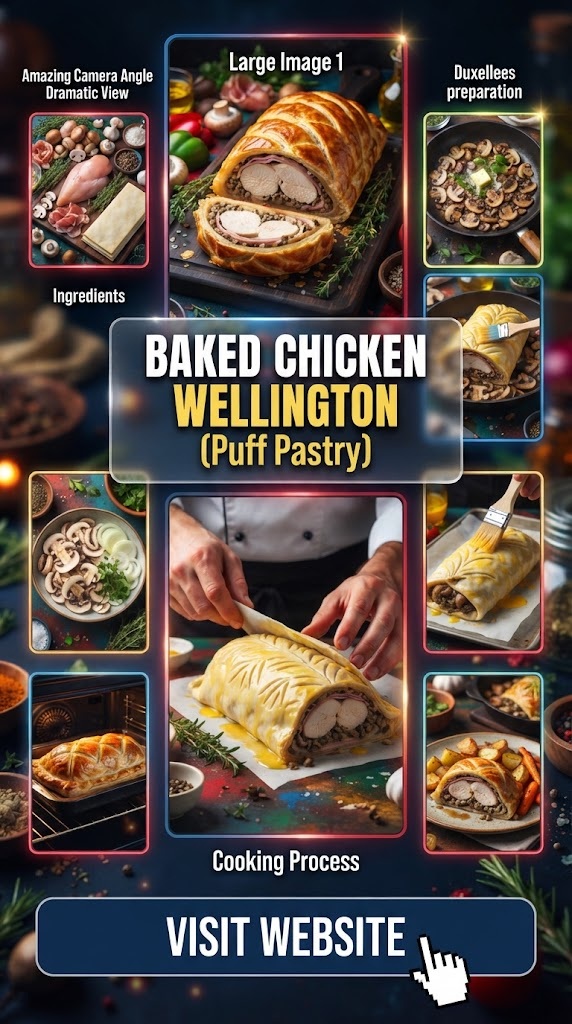
Baked Chicken Wellington (Puff Pastry)
Baked Chicken Wellington (Puff Pastry)
Baked Chicken Wellington is an elegant yet surprisingly approachable dinner made with tender chicken breast, a savory mushroom filling, creamy cheese, and golden puff pastry. Inspired by the classic Beef Wellington, this chicken version is lighter, budget-friendly, and perfect for a special family dinner, holiday table, date night, or impressive weekend meal.
The magic happens when juicy seasoned chicken is wrapped in buttery puff pastry with a flavorful filling. As it bakes, the pastry becomes crisp and deeply golden while the chicken cooks gently inside. Every slice reveals layers of flaky pastry, tender chicken, and savory filling.
This recipe focuses on achieving three things: fully cooked juicy chicken, crisp puff pastry, and a flavorful filling that does not make the pastry soggy.
Why You’ll Love This Baked Chicken Wellington
There are plenty of reasons to add this recipe to your dinner rotation.
Elegant but Easy
Although Chicken Wellington looks like something served at an upscale restaurant, the preparation is manageable in a home kitchen. Puff pastry does most of the visual work, giving the finished dish a beautiful golden appearance without requiring complicated pastry-making skills.
Tender Chicken
Chicken breast can sometimes become dry during baking, but proper preparation helps keep it moist. Pounding the chicken to an even thickness allows it to cook more consistently.
Flaky Puff Pastry
Frozen puff pastry is an excellent shortcut. You get beautiful layers of buttery pastry without spending hours making dough from scratch.
Great for Special Occasions
This recipe makes an impressive centerpiece for:
- Sunday dinner
- Christmas dinner
- Thanksgiving gatherings
- Easter meals
- Birthday dinners
- Anniversaries
- Date nights
- Dinner parties
- Family celebrations
Make-Ahead Friendly
Much of the preparation can be completed ahead of time. You can prepare the filling and chicken earlier in the day and assemble the Wellington shortly before baking.
Complete Recipe
Recipe Information
Recipe Name: Baked Chicken Wellington
Cuisine: American/European-inspired
Preparation Time: 30 minutes
Chilling Time: 15–20 minutes
Cooking Time: 30–40 minutes
Total Time: About 1 hour 15 minutes
Servings: 4
Difficulty: Moderate
Main Cooking Method: Baking
Ingredients
For the Chicken
- 4 boneless, skinless chicken breasts, approximately 6 ounces each
- 1 teaspoon salt
- ½ teaspoon freshly ground black pepper
- 1 teaspoon garlic powder
- ½ teaspoon onion powder
- ½ teaspoon paprika
- 1 tablespoon olive oil
For the Mushroom Filling
- 2 tablespoons butter
- 8 ounces mushrooms, finely chopped
- ½ medium yellow onion, finely diced
- 2 cloves garlic, minced
- ½ teaspoon dried thyme
- ¼ teaspoon salt
- ¼ teaspoon black pepper
- 2 tablespoons cream cheese
- 2 tablespoons grated Parmesan cheese
- 1 tablespoon chopped fresh parsley
For Assembly
- 1 package frozen puff pastry, approximately 17 ounces, thawed according to package directions
- 1 tablespoon Dijon mustard
- 1 large egg
- 1 tablespoon water
- 1 tablespoon all-purpose flour, for dusting
- Optional: sesame seeds or poppy seeds for topping
Equipment Needed
You do not need specialized equipment.
Prepare:
- Large skillet
- Cutting board
- Sharp knife
- Rolling pin
- Baking sheet
- Parchment paper
- Pastry brush
- Small bowl
- Meat thermometer
- Spoon or spatula
A meat thermometer is particularly useful because chicken should reach a safe internal temperature of 165°F (74°C) in the thickest part.
Ingredient Details
Chicken Breast
Boneless, skinless chicken breasts work especially well because they fit neatly inside puff pastry.
Choose chicken breasts that are similar in size so they cook at approximately the same rate.
If your chicken breasts are very thick, gently pound them between sheets of plastic wrap until they are more evenly shaped.
Do not pound them extremely thin. You want enough thickness to remain juicy after baking.
Puff Pastry
Store-bought frozen puff pastry is perfect for this recipe.
Allow it to thaw according to the package instructions, but keep it cool. Puff pastry becomes difficult to handle when it gets too warm.
If the pastry feels sticky or soft, place it in the refrigerator for several minutes before assembling.
Cold puff pastry produces better layers because the butter inside the pastry remains firm until it enters the hot oven.
Mushrooms
Mushrooms provide a deep savory flavor that pairs beautifully with chicken.
White button mushrooms, cremini mushrooms, or baby bella mushrooms all work well.
The most important part is chopping them finely and cooking away their excess moisture.
Do not rush this step.
A wet mushroom filling can release steam during baking and make the puff pastry soggy.
Cream Cheese
Cream cheese gives the filling a creamy texture and helps hold the mushrooms together.
You only need a small amount. Too much cream cheese can make the filling overly wet.
Parmesan Cheese
Parmesan adds salty, nutty flavor and makes the mushroom filling more savory.
Freshly grated Parmesan is preferable, but packaged grated Parmesan can also work.
How to Cook Baked Chicken Wellington
Step 1: Thaw the Puff Pastry
If using frozen puff pastry, thaw it according to the package instructions.
Keep the pastry refrigerated until you are ready to use it.
Do not leave it sitting at room temperature for too long.
Step 2: Prepare the Chicken
Place each chicken breast on a cutting board.
If the breasts are thick, place them between two pieces of plastic wrap.
Using a meat mallet or rolling pin, gently pound the chicken until it has a relatively even thickness.
You want the chicken to be approximately ½ to ¾ inch thick.
Pat the chicken dry with paper towels.
This is important because excess moisture can interfere with browning and make the pastry soggy.
Step 3: Season the Chicken
Combine:
- Salt
- Black pepper
- Garlic powder
- Onion powder
- Paprika
Season both sides of the chicken evenly.
Do not over-season because the mushroom filling and Parmesan will also provide flavor.
Step 4: Quickly Sear the Chicken
Heat olive oil in a large skillet over medium-high heat.
Once hot, place the chicken breasts into the skillet.
Sear for approximately 2–3 minutes per side.
The purpose of this step is primarily to develop flavor and lightly brown the outside.
You do not need to cook the chicken completely at this stage.
Transfer the chicken to a plate and allow it to cool.
This cooling step is important.
Do not wrap hot chicken in puff pastry because the heat can soften the pastry and cause poor browning.
Step 5: Prepare the Mushroom Filling
Melt butter in the same skillet over medium heat.
Add the diced onion.
Cook for approximately 3–4 minutes, stirring occasionally, until softened.
Add the minced garlic.
Cook for another 30–60 seconds.
Be careful not to burn the garlic.
Add the finely chopped mushrooms.
Stir everything together.
Cook for approximately 7–10 minutes.
The mushrooms will initially release moisture. Continue cooking until most of the liquid has evaporated.
The final mixture should look fairly dry and concentrated rather than watery.
Add:
- Thyme
- Salt
- Black pepper
Stir well.
Remove the skillet from the heat.
Step 6: Add the Cream Cheese and Parmesan
While the mushroom mixture is still warm, stir in the cream cheese.
Add Parmesan cheese and chopped parsley.
Mix until everything is evenly combined.
Taste the filling.
Add additional salt or pepper if necessary.
Transfer the filling to a bowl and allow it to cool completely.
This is another important step.
Never place a hot filling directly onto puff pastry.
Warm filling can melt the butter layers inside the pastry before baking.
Step 7: Prepare the Puff Pastry
Lightly dust your work surface with flour.
Place the thawed puff pastry on the surface.
Gently roll it out if necessary.
You want enough pastry to completely wrap each chicken breast with a small amount of overlap.
Avoid rolling the pastry excessively thin.
If it becomes too thin, it may tear or fail to puff properly.
Step 8: Spread Dijon Mustard
Place one cooled chicken breast on the puff pastry.
Spread a thin layer of Dijon mustard over the top of the chicken.
The mustard adds a subtle tangy flavor that balances the rich pastry and creamy mushroom filling.
Do not use too much.
A thin layer is enough.
Step 9: Add the Mushroom Filling
Spoon some of the cooled mushroom mixture over the chicken.
Spread it evenly.
Leave approximately ½ inch around the edges.
Keeping the edges clean makes sealing easier.
If you put too much filling in the center, the pastry may become difficult to close.
Step 10: Wrap the Chicken
Fold the puff pastry over the chicken.
Bring the edges together underneath or along the side.
Press the edges firmly to seal.
If necessary, brush a little water along the pastry edge before pressing it together.
You want the chicken completely enclosed.
Repeat with the remaining chicken breasts.
Step 11: Place on a Baking Sheet
Line a baking sheet with parchment paper.
Place each wrapped chicken Wellington seam-side down.
Leave a few inches between each piece.
This allows hot air to circulate around the pastry.
Step 12: Chill Before Baking
Place the assembled Wellingtons in the refrigerator for approximately 15–20 minutes.
This step is highly recommended.
Chilling firms the butter in the puff pastry and helps the pastry maintain its shape during baking.
It also makes the decorative scoring easier.
Step 13: Prepare the Egg Wash
In a small bowl, whisk together:
- 1 large egg
- 1 tablespoon water
Whisk until smooth.
This is your egg wash.
The egg wash gives the puff pastry its beautiful golden-brown color.
Step 14: Brush with Egg Wash
Remove the chicken Wellingtons from the refrigerator.
Brush the tops and exposed pastry evenly with egg wash.
Avoid allowing large amounts of egg wash to pool around the bottom edges.
Excess egg wash can interfere with crisping.
Step 15: Score the Pastry
Using a sharp knife, lightly score a decorative pattern on top.
You can create:
- Diagonal lines
- Crosshatch patterns
- Simple parallel cuts
- Small leaf shapes
Do not cut completely through the pastry.
You are only creating shallow decorative marks.
If desired, sprinkle the top with sesame seeds or poppy seeds.
Step 16: Bake
Preheat the oven to 400°F (200°C).
Place the baking sheet in the center of the oven.
Bake for approximately 30–40 minutes, depending on the size and thickness of the chicken.
The puff pastry should become deeply golden and crisp.
Most importantly, check the chicken with a meat thermometer.
The thickest part of the chicken should reach 165°F (74°C).
If the pastry becomes dark before the chicken reaches the required temperature, loosely cover the top with aluminum foil and continue baking.
Step 17: Rest the Chicken Wellington
Remove the chicken from the oven.
Allow it to rest for approximately 5–10 minutes before slicing.
Resting gives the juices time to redistribute.
It also allows the pastry to firm slightly.
Do not cut immediately after removing the Wellingtons from the oven.
Step 18: Slice and Serve
Use a sharp serrated or chef’s knife.
Slice each Wellington into thick pieces.
You should see:
- Golden puff pastry
- Tender chicken
- Creamy mushroom filling
- A savory interior
Serve immediately while the pastry is still crisp.
How to Prevent Soggy Puff Pastry
One of the biggest challenges with Chicken Wellington is keeping the pastry crisp.
Fortunately, several simple techniques make a major difference.
1. Cook the Mushrooms Thoroughly
Mushrooms contain a lot of water.
Cook them until the excess moisture has evaporated.
2. Cool the Filling
Never use steaming-hot filling.
Allow it to cool before assembling.
3. Cool the Chicken
The seared chicken should also be cooled before wrapping.
4. Don’t Overfill
Too much filling can release moisture and prevent the pastry from becoming crisp.
5. Keep Puff Pastry Cold
Cold pastry puffs better.
6. Use a Hot Oven
A properly preheated oven helps the pastry rise quickly.
7. Don’t Put the Wellington Into a Cold Oven
The pastry needs immediate high heat to develop its layers.
Tips for Perfect Chicken Wellington
Use Evenly Sized Chicken
Different-sized chicken breasts will cook at different speeds.
Try to use pieces that are approximately the same size.
Don’t Skip the Searing
Searing gives the chicken additional flavor and helps create a more appealing interior.
Don’t Fully Cook the Chicken in the Skillet
The chicken continues cooking in the oven.
Overcooking it before wrapping can result in dry chicken.
Cool Everything Before Assembly
This may be the most important preparation tip.
Hot ingredients soften puff pastry.
Don’t Stretch the Pastry Too Much
Stretching can cause the pastry to shrink during baking.
Seal the Edges Properly
Poorly sealed pastry can open during baking.
Press the seams firmly.
Don’t Overcrowd the Baking Sheet
Space between the Wellingtons allows better heat circulation.
What to Serve With Chicken Wellington
Chicken Wellington is rich and buttery, so fresh and lightly seasoned side dishes work especially well.
Roasted Vegetables
Roasted carrots, broccoli, Brussels sprouts, or green beans make excellent sides.
Their slight sweetness complements the savory chicken.
Mashed Potatoes
Creamy mashed potatoes create a comforting combination.
For extra flavor, add roasted garlic or fresh herbs.
Green Beans
Simple sautéed or roasted green beans provide freshness and color.
Side Salad
A crisp salad with mixed greens and a light vinaigrette can balance the richness of the pastry.
Roasted Asparagus
Asparagus pairs naturally with chicken and mushroom flavors.
Glazed Carrots
Honey-glazed carrots offer a sweet contrast to the savory filling.
Sauce Ideas
Chicken Wellington is flavorful enough to serve without sauce, but a sauce can make the dish even more luxurious.
Creamy Mushroom Sauce
Use mushrooms, butter, garlic, chicken stock, and a small amount of cream.
Dijon Cream Sauce
Combine Dijon mustard with cream and chicken stock for a tangy, rich sauce.
Garlic Herb Sauce
A simple butter sauce with garlic and fresh herbs works beautifully.
Chicken Gravy
A light homemade chicken gravy provides classic comfort-food flavor.
White Wine Sauce
For an adult dinner, a creamy white wine sauce can add acidity and sophistication.
Variations
Chicken and Spinach Wellington
Add cooked, well-drained spinach to the mushroom filling.
Make sure the spinach contains as little water as possible.
Chicken and Bacon Wellington
Add cooked, finely chopped bacon to the filling.
The smoky bacon works particularly well with mushrooms.
Chicken and Cheese Wellington
Add a thin layer of mozzarella, Gruyère, Swiss cheese, or cheddar.
Avoid using too much cheese because melted cheese can make the pastry difficult to seal.
Garlic Herb Chicken Wellington
Add fresh rosemary, thyme, parsley, and extra garlic to the filling.
Spinach and Feta Chicken Wellington
Replace some of the cream cheese with crumbled feta and combine it with well-drained spinach.
Chicken Wellington With Caramelized Onions
Slowly caramelized onions add sweetness and complexity.
Make sure they are cooled before assembly.
Make-Ahead Instructions
Chicken Wellington can be partially prepared ahead of time.
Prepare the chicken and mushroom filling earlier in the day.
Cool both completely.
Wrap the chicken in puff pastry and place the assembled Wellingtons in the refrigerator.
Keep them covered until ready to bake.
For the best pastry texture, bake them the same day.
If preparing ahead, do not leave uncooked chicken wrapped in pastry at room temperature.
Keep it refrigerated.
Storage Instructions
Allow leftover Chicken Wellington to cool.
Place leftovers in an airtight container and refrigerate.
They are best consumed within 3–4 days when properly refrigerated.
How to Reheat Chicken Wellington
The oven is the best method because it helps restore crispness to the pastry.
Preheat the oven to approximately 350°F (175°C).
Place the Wellington on a baking sheet.
Heat until warmed through.
Avoid microwaving if possible.
Microwaves heat the filling quickly but make puff pastry soft and chewy.
An air fryer can also work well for reheating individual portions.
Freezing Instructions
Chicken Wellington can be frozen, although freshly baked pastry generally provides the best texture.
If freezing assembled uncooked Wellington, wrap it tightly and store it in a freezer-safe container.
When ready to cook, follow safe food-handling practices and ensure the chicken reaches 165°F (74°C) internally.
Because frozen pastry and chicken can require additional cooking time, use the internal temperature rather than relying only on the recipe’s estimated baking time.
Common Mistakes
Mistake 1: Wet Mushroom Filling
This is one of the most common problems.
Solution: Cook the mushrooms until their moisture has evaporated.
Mistake 2: Wrapping Hot Chicken
Hot chicken can soften the pastry.
Solution: Cool the chicken before assembly.
Mistake 3: Too Much Filling
Excess filling can cause the pastry to split.
Solution: Use a moderate layer.
Mistake 4: Pastry Is Pale
This usually means insufficient egg wash or inadequate baking.
Solution: Brush evenly with egg wash and bake in a fully preheated oven.
Mistake 5: Pastry Burns Before Chicken Is Done
The oven may be too hot for the particular size of your chicken, or the chicken breasts may be unusually thick.
Solution: Cover the pastry loosely with foil and continue cooking until the chicken reaches 165°F (74°C).
Mistake 6: Pastry Does Not Puff
Possible causes include warm pastry, an underheated oven, or excessive handling.
Solution: Keep the pastry cold and preheat the oven thoroughly.
Frequently Asked Questions
Can I use chicken thighs?
Yes. Boneless, skinless chicken thighs can be used, although their irregular shape can make wrapping more difficult.
Chicken breasts are easier to shape into neat Wellington portions.
Can I skip the mushrooms?
Absolutely.
You can replace the mushroom filling with spinach, caramelized onions, cheese, or another relatively dry filling.
Can I use refrigerated puff pastry?
Yes.
Either refrigerated or properly thawed frozen puff pastry can work.
Can I make one large Chicken Wellington?
Yes.
Instead of making four individual portions, you can wrap several chicken breasts together in one larger piece of puff pastry.
However, individual Wellingtons are generally easier to cook evenly.
Why is my pastry soggy underneath?
The most common causes are excessive filling moisture, hot filling, or insufficient oven heat.
Make sure the mushroom mixture is well cooked and cooled.
Do I need to brush the bottom with egg wash?
No.
Egg wash is mainly used on the exposed pastry surface.
Can I add cheese?
Yes.
Gruyère, Swiss, mozzarella, cheddar, or Parmesan can work.
Use cheese moderately to avoid excessive moisture and leakage.
How do I know when the chicken is done?
Use an instant-read meat thermometer.
The thickest part of the chicken should reach 165°F (74°C).
Do not rely solely on pastry color to determine whether the chicken is cooked.
Nutritional Information
Approximate nutrition per serving will vary depending on the size of the chicken breasts, puff pastry brand, cheese, and other ingredients.
A typical serving may contain approximately:
- Calories: 650–750
- Protein: 50–60 g
- Carbohydrates: 35–45 g
- Fat: 30–40 g
- Saturated Fat: 12–18 g
- Fiber: 2–4 g
- Sodium: 700–1,000 mg
These numbers are estimates and should not be treated as laboratory measurements.
Complete Ingredient Summary
For easy reference, gather:
Chicken
- 4 chicken breasts
- Salt
- Black pepper
- Garlic powder
- Onion powder
- Paprika
- Olive oil
Mushroom Filling
- Butter
- Mushrooms
- Yellow onion
- Garlic
- Thyme
- Cream cheese
- Parmesan
- Fresh parsley
- Salt and pepper
Pastry
- Puff pastry
- Dijon mustard
- Egg
- Water
- Flour
Optional
- Sesame seeds
- Poppy seeds
- Fresh herbs
Detailed Cooking Timeline
0–10 Minutes
Prepare and season the chicken.
10–20 Minutes
Sear the chicken and set aside to cool.
20–35 Minutes
Cook the onion, garlic, and mushrooms.
35–40 Minutes
Finish the mushroom filling with cream cheese, Parmesan, and parsley.
40–50 Minutes
Cool the filling and prepare the puff pastry.
50–60 Minutes
Assemble the Chicken Wellington.
60–80 Minutes
Chill and bake.
80–90 Minutes
Rest, slice, and serve.
Chef’s Tips for the Best Results
The quality of your Chicken Wellington depends more on technique than expensive ingredients.
First, control moisture. Mushrooms should be cooked until their water has evaporated. This creates a concentrated filling instead of a watery one.
Second, control temperature. Chicken and filling should be cooled before they touch the pastry. Puff pastry performs best when it begins cold and enters a hot oven.
Third, avoid overfilling. A thinner, evenly distributed layer is better than a large mound.
Fourth, seal carefully. Make sure there are no gaps in the pastry.
Fifth, use egg wash. It creates the attractive golden finish associated with classic Wellington-style dishes.
Finally, use a thermometer. Pastry color tells you how the exterior is cooking, but only the internal temperature reliably tells you whether the chicken has reached a safe temperature.
Serving Presentation
For a restaurant-style presentation, place a few slices of Chicken Wellington slightly overlapping on each plate.
Add roasted asparagus or green beans beside the chicken.
Drizzle a small amount of Dijon cream sauce around the plate rather than pouring it directly over the pastry. This helps preserve the crisp texture.
Finish with chopped parsley or fresh thyme.
The golden pastry provides a beautiful centerpiece, while colorful vegetables make the plate look fresh and inviting.
Final Thoughts
Baked Chicken Wellington is one of those recipes that looks far more complicated than it actually is. The combination of tender seasoned chicken, savory mushroom filling, creamy cheese, and crisp puff pastry creates an impressive meal with relatively simple ingredients.
The key to success is moisture control, temperature control, and proper cooking time. Cook the mushrooms thoroughly, cool the filling and chicken before wrapping, keep the puff pastry cold, and bake in a properly preheated oven.
When the pastry turns deeply golden and flaky and the chicken reaches 165°F (74°C) internally, you have a beautiful centerpiece worthy of a special occasion.
Serve it with roasted vegetables, mashed potatoes, asparagus, or a fresh green salad, and finish with your favorite light sauce.
With its crisp exterior and savory, tender center, this Baked Chicken Wellington is an elegant dinner that can turn an ordinary evening into something special.