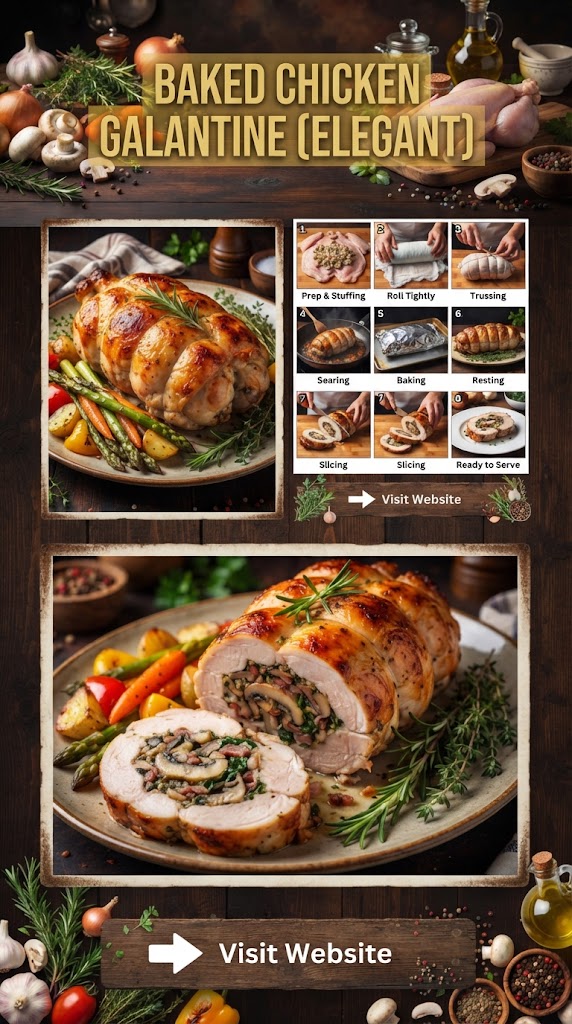
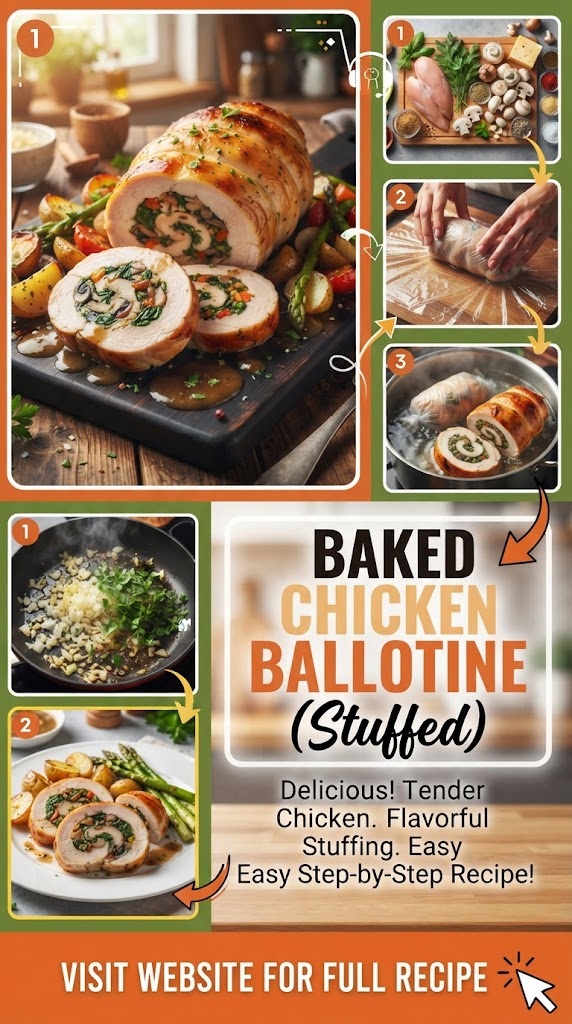
Baked Chicken Ballotine (Stuffed)
Baked Chicken Ballotine (Stuffed)
Baked Chicken Ballotine is an elegant French-inspired dish made by carefully removing the chicken bones, filling the meat with a flavorful stuffing, rolling it into a neat cylinder, and baking it until beautifully golden on the outside and juicy inside. Although it looks like something you would order at a fine-dining restaurant, it can absolutely be prepared in a home kitchen with patience and a few simple techniques.
This stuffed chicken recipe is ideal for holidays, dinner parties, Sunday dinners, special occasions, or whenever you want to turn ordinary chicken into an impressive centerpiece. The combination of tender chicken, savory herb stuffing, garlic, vegetables, cheese, and a beautifully browned exterior makes every slice look as good as it tastes.
The key to a successful chicken ballotine is preparation. The chicken needs to be flattened evenly, the filling should be flavorful but not excessively wet, and the roll must be tied securely so that it keeps its shape during baking. Once you understand these steps, the process becomes much easier.
What Is Chicken Ballotine?
A ballotine is a classic culinary preparation in which poultry or another meat is boned, stuffed, rolled, and cooked. The finished meat is typically shaped into a compact cylinder and sliced before serving.
For this baked version, a whole chicken is deboned while keeping the skin intact. The meat is then spread flat and seasoned before being covered with stuffing. The chicken is rolled tightly around the filling, tied with kitchen twine, and baked.
The result is a beautiful dish with several layers: browned chicken skin on the outside, juicy chicken meat underneath, and a savory stuffing in the center.
Unlike a simple stuffed chicken breast, a ballotine creates attractive slices in which the filling is surrounded by chicken. This makes it especially suitable for entertaining.
Why You’ll Love This Recipe
There are many reasons to make Baked Chicken Ballotine at home.
Elegant presentation: When sliced, the rolled chicken creates a restaurant-style presentation.
Tender and flavorful: The stuffing adds moisture, herbs, aromatics, and richness to the chicken.
Perfect for entertaining: Much of the preparation can be completed before the chicken goes into the oven.
Customizable: You can change the stuffing according to your favorite ingredients.
Excellent leftovers: Thin slices of leftover ballotine can be used in sandwiches, salads, wraps, or grain bowls.
A complete centerpiece: Serve it with roasted vegetables, potatoes, salad, or a simple pan sauce for an impressive meal.
Complete Baked Chicken Ballotine Recipe
Prep Time
45–60 minutes
Cooking Time
Approximately 60–80 minutes
Resting Time
15–20 minutes
Total Time
About 2 hours
Servings
6–8
Course
Main Course
Cuisine
French-inspired
Cooking Method
Baking/Roasting
Ingredients
For the Chicken
- 1 whole chicken, approximately 4–5 pounds
- 2 tablespoons olive oil
- 1 ½ teaspoons kosher salt
- 1 teaspoon freshly ground black pepper
- 1 teaspoon garlic powder
- 1 teaspoon dried thyme
- ½ teaspoon dried rosemary
- ½ teaspoon paprika
- 1 tablespoon fresh parsley, finely chopped
- 2 cloves garlic, minced
For the Stuffing
- 2 tablespoons butter
- 1 small yellow onion, finely diced
- 2 celery stalks, finely diced
- 2 cloves garlic, minced
- 8 ounces mushrooms, finely chopped
- 2 cups fresh breadcrumbs
- ½ cup grated Parmesan cheese
- ¼ cup fresh parsley, chopped
- 1 tablespoon fresh thyme leaves
- 1 teaspoon dried sage
- ½ teaspoon salt
- ½ teaspoon black pepper
- 1 large egg
- ¼ cup chicken broth
- 2 tablespoons heavy cream
- 2 tablespoons butter, melted
Optional Cheese Layer
- ½ cup shredded mozzarella
- ½ cup shredded Gruyère or Swiss cheese
For the Baking Pan
- 1 large onion, sliced
- 2 carrots, roughly chopped
- 2 celery stalks, roughly chopped
- 1 cup chicken broth
- ½ cup dry white wine or additional chicken broth
- 2 sprigs fresh thyme
- 1 sprig fresh rosemary
For a Simple Pan Sauce
- 1 tablespoon butter
- 1 tablespoon all-purpose flour
- 1 cup strained pan juices
- ½ cup chicken broth
- Salt, to taste
- Black pepper, to taste
Ingredient Notes
Whole Chicken
Choose a whole chicken large enough to create a substantial roll. A 4- to 5-pound chicken works particularly well for six to eight servings.
The most important thing is to keep the skin intact during deboning. The skin will become the outer layer of the ballotine and helps protect the meat while it cooks.
Breadcrumbs
Fresh breadcrumbs provide a softer, more tender stuffing. You can make them by pulsing day-old bread in a food processor.
Dry breadcrumbs can also be used, but you may need slightly more chicken broth to achieve the correct consistency.
Mushrooms
Mushrooms add savory depth and a pleasant meaty texture. White mushrooms, cremini mushrooms, or a mixture of wild mushrooms can be used.
Make sure the mushrooms are cooked until most of their moisture has evaporated. Wet stuffing can make the ballotine difficult to roll and may affect the texture.
Parmesan
Parmesan contributes saltiness and umami. Gruyère can also be added for a richer, more luxurious stuffing.
Fresh Herbs
Parsley, thyme, rosemary, and sage work especially well with chicken. Fresh herbs give the stuffing a brighter flavor, while dried herbs provide a more concentrated taste.
How to Debone the Chicken
Deboning the chicken is the most technical part of this recipe, but you do not need professional culinary skills to attempt it.
Start with the chicken breast-side down on a sturdy cutting board.
Use a sharp boning knife or small flexible knife.
Carefully make a cut along one side of the backbone. Follow the bones while keeping your knife close to the carcass.
Repeat on the other side.
Remove the backbone.
Next, work around the thigh and leg bones. Carefully separate the meat from the bones while preserving as much meat as possible.
Remove the thigh bones and drumsticks if you are comfortable doing so.
The goal is to create a relatively flat sheet of chicken meat attached to the skin.
Do not worry if the shape isn’t perfectly rectangular. The important thing is that the meat can be flattened and rolled.
If deboning a whole chicken feels too difficult, ask a butcher to debone the chicken while keeping the skin intact. This is an excellent shortcut and makes the recipe much easier.
Preparing the Stuffing
Begin by melting the butter in a large skillet over medium heat.
Add the diced onion and celery.
Cook for approximately 4–5 minutes, stirring occasionally, until the vegetables begin to soften.
Add the minced garlic and cook for about 30 seconds.
Add the chopped mushrooms.
Cook for approximately 7–10 minutes.
The mushrooms should become tender and most of their liquid should evaporate.
This step is important because excess mushroom moisture can make the stuffing too wet.
Remove the skillet from the heat.
Allow the vegetable mixture to cool for several minutes.
In a large bowl, combine the breadcrumbs, Parmesan, parsley, thyme, sage, salt, and black pepper.
Add the cooled vegetable mixture.
Beat the egg with the chicken broth and heavy cream.
Pour the liquid mixture into the stuffing.
Add the melted butter.
Mix gently until everything is evenly combined.
The stuffing should be moist enough to hold together when pressed but should not be soggy.
Preparing the Chicken
Place the deboned chicken skin-side down on a large cutting board.
Spread the meat outward so you have a relatively even layer.
If some areas are much thicker than others, carefully butterfly or lightly pound the thicker portions.
Place plastic wrap over the chicken if pounding it and use a meat mallet to gently even out the thickness.
Do not pound aggressively. You want to flatten the chicken without tearing the meat or skin.
Season the chicken with salt, black pepper, garlic powder, thyme, rosemary, paprika, and fresh parsley.
Add the minced garlic and rub the seasoning gently over the meat.
Adding the Stuffing
Spread the prepared stuffing evenly over the chicken.
Leave approximately 1 inch of space around the edges.
This is important because the stuffing will move slightly when the chicken is rolled.
If using cheese, sprinkle the mozzarella and Gruyère evenly over the stuffing.
Do not overload the filling.
Too much stuffing makes rolling difficult and can cause the filling to escape during cooking.
The filling should form an even layer rather than a thick mound.
Rolling the Ballotine
This is one of the most important steps.
Start from one long side of the chicken.
Begin rolling the chicken firmly around the stuffing.
Keep the roll tight but do not squeeze so hard that the stuffing comes out.
Continue rolling until the chicken forms a compact cylinder.
The skin should be on the outside.
If a small amount of filling escapes from the ends, gently push it back into the roll.
Once rolled, place the chicken seam-side down temporarily.
Tying the Chicken
Kitchen twine is essential because it keeps the ballotine together while it cooks.
Cut several lengths of butcher’s twine.
Tie the chicken at approximately 1½- to 2-inch intervals.
Then use one longer piece of twine to secure the length of the roll if necessary.
The goal is to create a firm, evenly shaped cylinder.
Do not tie the twine so tightly that it cuts deeply into the chicken.
A secure but moderate tension is sufficient.
Once tied, inspect the ballotine.
The roll should look compact and evenly shaped.
Preparing the Baking Pan
Preheat the oven to 375°F (190°C).
Place the sliced onion, carrots, celery, thyme, and rosemary into a roasting pan or large baking dish.
Pour in the chicken broth and white wine.
The vegetables create a flavorful base for the pan juices.
Place a rack over the vegetables if available.
Put the chicken ballotine on the rack with the seam side facing downward.
If you don’t have a rack, place the chicken directly on the vegetables.
The important thing is that the chicken is elevated slightly so hot air can circulate around it.
Baking the Chicken Ballotine
Brush the outside of the chicken with olive oil.
Season the skin lightly with salt and black pepper.
Place the chicken in the preheated oven.
Bake at 375°F (190°C).
The exact cooking time depends on the size and thickness of the ballotine.
A 4-pound chicken typically requires approximately 60–75 minutes, but temperature is a much more reliable indicator than time.
Insert an instant-read thermometer into the thickest portion of the chicken, avoiding the center stuffing if possible.
The chicken should reach a safe internal temperature of 165°F (74°C).
If the skin becomes too dark before the center is cooked, loosely cover the chicken with aluminum foil.
For extra-crispy skin, remove the foil during the final 10–15 minutes.
How to Know When It Is Done
Do not rely only on color.
A beautifully browned exterior does not necessarily mean the center is cooked.
Use an instant-read thermometer.
Check the thickest section of the chicken.
The internal temperature should reach 165°F (74°C).
The stuffing should also be thoroughly hot.
Once the ballotine reaches the correct temperature, remove it from the oven.
Resting the Ballotine
Resting is extremely important.
Transfer the cooked ballotine to a cutting board.
Loosely cover it with foil.
Allow it to rest for approximately 15–20 minutes.
During this time, the juices redistribute throughout the meat.
Resting also makes slicing much easier.
If you cut the ballotine immediately, the juices may run onto the cutting board and the slices may fall apart.
Removing the Twine
Before slicing, carefully cut and remove every piece of kitchen twine.
Use kitchen scissors or a sharp knife.
Make sure no piece of twine remains hidden underneath the chicken.
Do not attempt to slice through the twine because it can make the slices messy and difficult to serve.
How to Slice Chicken Ballotine
Use a sharp carving knife.
Slice the ballotine into rounds approximately ¾ to 1 inch thick.
Make clean, confident cuts.
Avoid using a sawing motion because it can crush the stuffing.
Arrange the slices on a warm serving platter.
The cross-section should show the chicken surrounding the colorful stuffing.
This is where the ballotine really becomes impressive.
Making the Pan Sauce
Do not throw away the pan juices.
They contain concentrated chicken, vegetable, herb, and roasting flavors.
Strain the pan juices into a measuring cup.
Allow the fat to rise to the surface.
Melt 1 tablespoon of butter in a saucepan.
Add 1 tablespoon flour.
Whisk continuously for approximately 1 minute.
Slowly add 1 cup of strained pan juices while whisking.
Add chicken broth as necessary to achieve the desired consistency.
Simmer for approximately 3–5 minutes.
Taste.
Add salt and black pepper if needed.
The finished sauce should be smooth, savory, and lightly thickened.
Serve it alongside the sliced ballotine or spoon a small amount over each portion.
What to Serve With Baked Chicken Ballotine
Because this is a rich and elegant main dish, simple side dishes work beautifully.
Garlic Mashed Potatoes
Creamy mashed potatoes are excellent with the pan sauce.
Roasted Vegetables
Carrots, Brussels sprouts, zucchini, asparagus, or green beans provide color and freshness.
Herb-Roasted Potatoes
Crispy roasted potatoes add a wonderful contrast to the tender chicken.
Green Salad
A simple salad dressed with lemon vinaigrette helps balance the richness of the stuffing.
Glazed Carrots
Sweet carrots complement the savory chicken and herbs.
Buttered Green Beans
Fresh green beans with butter, lemon, and black pepper are an easy elegant side.
Tips for Perfect Chicken Ballotine
1. Keep the Skin Intact
The skin is what gives the ballotine its beautiful appearance.
When deboning, work slowly and keep the knife close to the bones.
2. Don’t Make the Stuffing Too Wet
Excess liquid makes the filling difficult to control.
The stuffing should be moist but firm.
3. Don’t Overfill
A moderate layer of stuffing is better than a huge amount.
Too much filling can cause the roll to split.
4. Roll Tightly
A firm roll creates attractive slices.
5. Tie Securely
Use kitchen twine at regular intervals.
6. Use a Thermometer
Cooking time varies.
Internal temperature is the most dependable way to determine doneness.
7. Rest Before Cutting
Allowing the chicken to rest helps maintain moisture and makes slicing easier.
Common Mistakes to Avoid
Using Too Much Filling
One of the most common mistakes is adding too much stuffing.
It may look tempting to create a thick filling layer, but the chicken must still be able to close around it.
Keep the stuffing layer relatively thin and even.
Rolling Too Loosely
A loose roll can fall apart during slicing.
Keep steady pressure as you roll.
Cutting the Chicken Immediately
Freshly baked chicken is fragile.
Rest it first.
Ignoring Internal Temperature
Color isn’t a reliable indicator of doneness.
Always check the thickest portion with a thermometer.
Overcooking the Chicken
Chicken breast meat can become dry if cooked far beyond the required temperature.
Once the ballotine reaches 165°F (74°C), remove it from the oven.
Not Cooking the Mushrooms Properly
Raw mushrooms release a lot of liquid.
Cook them until their moisture has largely evaporated before adding them to the stuffing.
Variations
The beauty of chicken ballotine is that the filling can be changed in countless ways.
Spinach and Cheese Ballotine
Add sautéed spinach, ricotta, Parmesan, and mozzarella.
This creates a colorful green-and-white filling.
Mushroom and Gruyère Ballotine
Use a generous mixture of mushrooms, Gruyère, thyme, and garlic.
This is especially luxurious.
Cranberry and Herb Ballotine
For a holiday variation, add dried cranberries, sage, parsley, and toasted walnuts.
The sweet-tart cranberries provide excellent contrast.
Spinach and Sun-Dried Tomato
Combine sautéed spinach, chopped sun-dried tomatoes, garlic, Parmesan, and mozzarella.
The colors look beautiful when sliced.
Sausage Stuffed Ballotine
Add cooked Italian sausage to the stuffing.
This creates an especially rich and hearty dish.
Apple and Sage Ballotine
For an autumn-inspired version, combine diced sautéed apple, sage, breadcrumbs, onion, and sausage.
Make-Ahead Instructions
Chicken ballotine is particularly useful for entertaining because much of the work can be done in advance.
Prepare the stuffing and chicken.
Roll and tie the ballotine.
Place it in a covered container or wrap it securely.
Refrigerate until ready to bake.
For best food safety, keep the raw chicken refrigerated and cook it within a reasonable period according to standard poultry-storage guidance.
Remove the chicken from the refrigerator shortly before cooking so that the exterior isn’t extremely cold, but don’t leave raw poultry sitting at room temperature for extended periods.
Storage
Allow leftover chicken to cool and place it in an airtight container.
Refrigerate promptly.
Leftover chicken ballotine can be kept refrigerated for several days.
For longer storage, wrap individual slices tightly and freeze them in a freezer-safe container.
Thaw frozen chicken in the refrigerator rather than at room temperature.
How to Reheat
The best way to reheat ballotine is gently.
Place slices in a baking dish.
Add a small amount of chicken broth or pan sauce.
Cover loosely with foil.
Warm in a moderate oven until heated through.
Avoid very high heat because it can dry the chicken.
For individual servings, gentle reheating in a covered skillet with a little broth also works well.
Serving for a Dinner Party
For an elegant presentation, arrange several slices slightly overlapping on a large platter.
Drizzle a small amount of pan sauce around the chicken rather than completely covering it.
Garnish with fresh parsley or thyme.
Add roasted vegetables around the edges.
For an upscale presentation, place a small spoonful of sauce beneath each slice.
This allows the beautiful stuffing pattern to remain visible.
Frequently Asked Questions
Can I make chicken ballotine without deboning a whole chicken?
Yes. You can use boneless chicken thighs or several large chicken breasts, but the classic ballotine technique uses a deboned whole chicken.
Can a butcher debone the chicken?
Absolutely. This is one of the easiest ways to simplify the recipe. Ask the butcher to remove the bones while keeping the skin intact.
Can I use chicken thighs?
Yes. Chicken thighs are naturally juicy and can work wonderfully for smaller individual ballotines.
Can I change the stuffing?
Definitely. Mushrooms, spinach, cheese, sausage, herbs, vegetables, nuts, and dried fruit can all be incorporated.
Why did my stuffing fall out?
Usually this happens because the roll wasn’t tight enough, the filling was too wet, or too much filling was used.
Can I prepare the ballotine the day before?
Yes. Prepare and tie it ahead of time, refrigerate it properly, and bake it when ready.
Why is my chicken dry?
It may have been cooked too long or at too high a temperature. Use an instant-read thermometer and remove it once it reaches the recommended safe temperature.
Nutrition Information
Nutrition varies depending on the exact chicken size, stuffing ingredients, cheese, and portion size. A typical serving can provide substantial protein along with fat from the chicken skin, butter, cheese, and olive oil.
For a lighter version, reduce the cheese and butter, use more vegetables in the stuffing, and remove some of the skin before serving.
Expert-Level Tips for Restaurant-Style Results
For a truly polished ballotine, focus on consistency.
The thickness of the chicken should be as even as possible.
The stuffing should be evenly distributed.
The roll should be cylindrical rather than tapered.
The twine should be spaced consistently.
The skin should be dry before seasoning so it browns properly.
You can also briefly chill the tied ballotine before baking. Chilling firms the shape and makes the roll easier to handle.
Another useful technique is to brown the ballotine in a large oven-safe skillet before transferring it to the oven. Browning the skin first creates deeper roasted flavor and helps produce a beautiful golden exterior.
If you choose this method, use moderate heat and rotate the chicken carefully so that several sides develop color.
Final Recipe Summary
Baked Chicken Ballotine is an impressive stuffed chicken dish that combines tender roasted poultry with a flavorful herb, mushroom, breadcrumb, and cheese filling.
The most important steps are:
- Debone the chicken while keeping the skin intact.
- Prepare a flavorful but not overly wet stuffing.
- Flatten and season the chicken evenly.
- Spread the stuffing in a thin layer.
- Roll the chicken tightly.
- Secure it with kitchen twine.
- Roast at 375°F (190°C).
- Cook until the thickest part reaches 165°F (74°C).
- Rest for 15–20 minutes.
- Remove the twine and slice into attractive rounds.
- Serve with pan sauce and your favorite vegetables or potatoes.
The final dish is golden, juicy, savory, and visually impressive. Every slice reveals a beautiful spiral of stuffing surrounded by tender chicken, making this recipe an excellent choice for holidays, celebrations, family gatherings, or an elegant weekend dinner.
If you have never prepared a ballotine before, don’t be intimidated by the technique. The first attempt may take a little longer, but once you understand how to debone, fill, roll, and tie the chicken, the process becomes surprisingly manageable.
The reward is a centerpiece that looks sophisticated while using familiar, comforting ingredients. With a crisp golden exterior, juicy chicken, aromatic herbs, savory mushrooms, creamy cheese, and a rich pan sauce, Baked Chicken Ballotine (Stuffed) is a memorable dish that turns an ordinary chicken dinner into something truly special.